


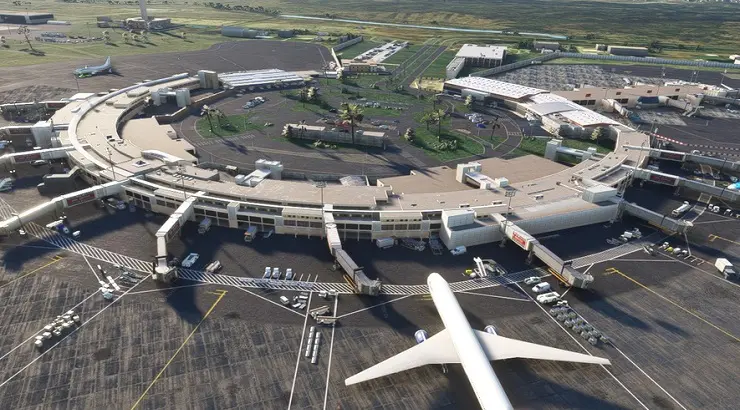
Jomo Kenyatta International Airport (JKIA), Kenya’s international gateway and a critical regional aviation hub, is set for a massive transformation. As the hub for Kenya Airways (KQ) and a major transit hub for various international airlines, the airport is a vital driver of national, regional and international connectivity. However, current figures show that JKIA is operating significantly beyond its intended limits.
In 2025, the airport handled approximately 8.93 million passengers, far exceeding its design capacity of roughly 7.5 million by 20%. To address this, the Kenya Airports Authority (KAA) concluded an Integrated Master Plan and Feasibility Study in February 2026, leading to a phased development approach aimed at both immediate relief and long-term growth.
JKIA Expansion Phases
The first phase of the expansion will focus on enhancing existing infrastructure to meet imminent demand. Currently, the airport suffers from significant congestion across its runway system, passenger terminals, and apron areas. Key upgrades planned for the existing facilities include the construction of a partial parallel taxiway and two rapid exit taxiways to reduce runway occupancy times and increase throughput. Re-configuring and selectively expanding existing terminals will be done to address current operational bottlenecks.
KAA also plans to modernize passenger processing systems including check-in, security screening, immigration, and baggage handling to improve service levels and efficiency. And optimizing existing vehicle parking and improving land-side access roads to reduce road congestion.
In their study, the comprehensive traffic forecasting shows that by 2045, passenger traffic will grow to approximately 22.31 million annually, while air cargo is expected to more than double to 860,400 tons. To accommodate this, the KAA has plans to develop a brand-new terminal capable of accommodating an additional 10 million passengers per year. It also wants to upgrade air traffic control, firefighting stations, cargo facilities, and utility infrastructure and develop new taxiways, aprons, and aircraft support facilities to handle increased aircraft traffic.
A major part of this expansion is the development of an Airport City and a Special Economic Zone (SEZ). These initiatives are designed to maximize the airport’s economic value by attracting logistics, trade, and manufacturing.
The SEZ will support high-value, export-oriented industries such as agro-processing, pharmaceuticals, and e-commerce fulfillment. Complementing this, the Airport City will host business parks, corporate offices, hotels, and convention facilities. Together, these developments are expected to generate significant employment, attract foreign investment, and diversify national revenues in alignment with Kenya Vision 2030.

Cabinet Secretary for Roads & Transport, Davis Chirchir, emphasized that this expansion is a strategic initiative to safeguard JKIA’s role as a leading regional gateway. By addressing capacity shortfalls and embracing a phased development approach, the government aims to ensure JKIA remains a robust and flexible framework for Kenya’s future aviation needs.
Also read: KQ and TUI Join Forces to Launch KQ Holidays, Enhancing Year Round Travel to Africa


