


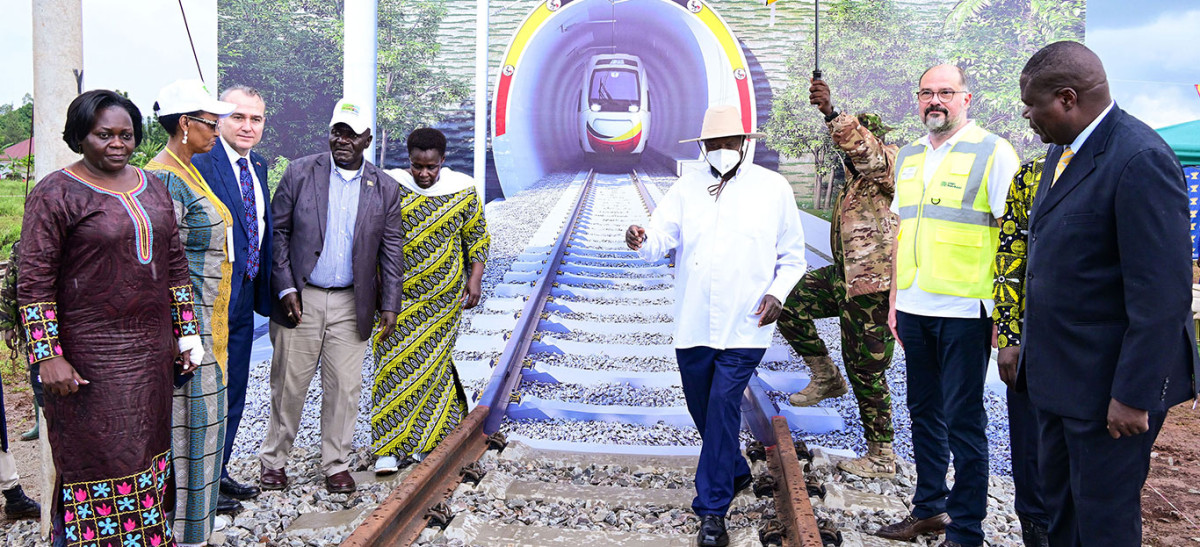
The Government of Uganda is in the advanced stages of issuing its first-ever sovereign Sukuk bond, a move designed to diversify its funding sources for the Standard Gauge Railway (SGR) project. This inaugural Shariah-compliant bond aims to raise €405.5 million, which will cover 15% of the total €2.7 billion required for the first phase of the railway’s construction.
The Cabinet approved the SGR financing structure in January 2025. According to the Ministry of Finance 60% of the funding will be sourced from Export Credit Agencies (ECAs) and 25% from Development Finance Institutions (DFIs), the remaining 15% will be generated through the Sukuk issuance.
Uganda’s Strategic Shift in Financing
The shift toward Islamic finance is a response to tightening global credit markets and rising public debt, which is projected to reach 55.5% by June 2026. Unlike conventional bonds that rely on interest payments, Sukuk is asset-backed, offering investors beneficial ownership in the project’s tangible assets through a Special Purpose Vehicle (SPV). Investors will earn rental income from the operational railway, with a planned annual rental rate of 10.5% over a seven-year term.
The first phase of the project involves a 272-km (or 273-km) line stretching from the Kenyan border at Malaba to Kampala. Once completed, the SGR is expected to revolutionize regional trade by reducing transit times, lowering freight costs which are expected to drop by 35% compared to the existing metre-gauge system. Notably, high-speed travel will reach up to 120 km/h for passengers and 100 km/h for freight.
Furthermore, the project targets a 40% local content requirement to benefit Ugandan firms and supports the country’s long-term goal of achieving a $500 billion GDP by 2040. Future phases are planned to extend the network to the borders of Rwanda, the Democratic Republic of Congo (DRC), and Tanzania.
The Deputy Secretary to the Treasury, Patrick Ocailap, is currently leading a high-level delegation on a Sukuk Roadshow across the East African Community (EAC), including Kenya, Tanzania, and Zanzibar. The primary goals of this roadshow are market sounding, pricing discovery, and building relations with potential investors, particularly those in the Middle East’s $4.9 trillion Islamic finance market.
The Sukuk bond is designed to be accessible, with a minimum investment of $265, and will be listed on the Uganda Securities Exchange as well as international markets. To encourage participation, the government has designated returns as tax-exempt for infrastructure bonds with a tenor of 10 years or more.

Also read: Treasury Allocates KES 1.1 Billion to Consolidated Bank Recapitalization


