


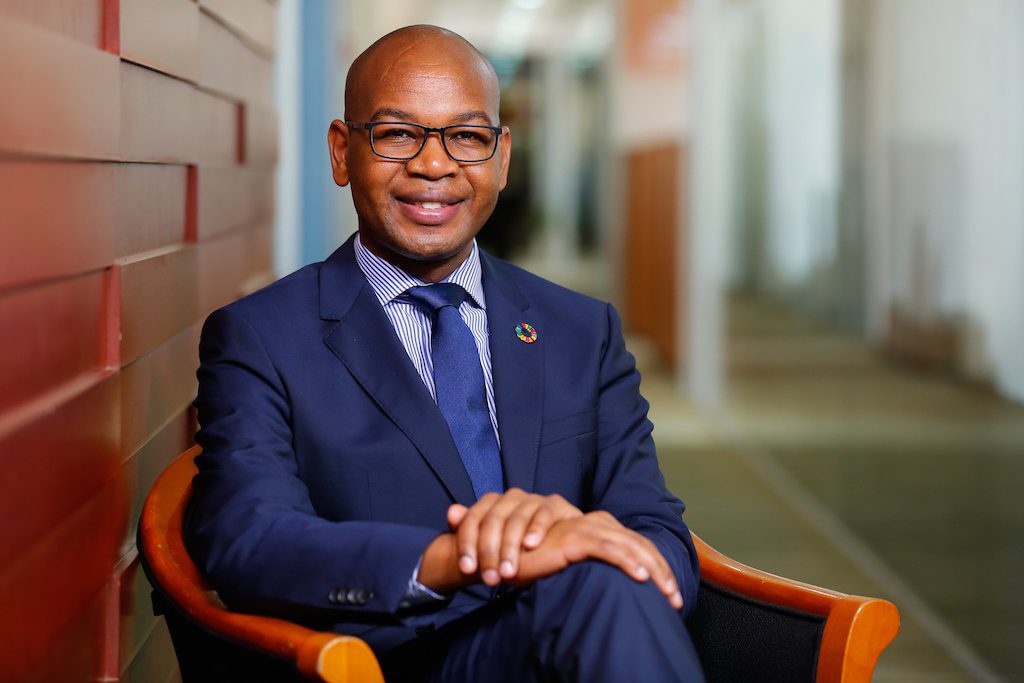
Africa’s biggest lender by assets is done waiting for the acquisition maths to work in Ethiopia. Stanbic Bank, the East African subsidiary of South Africa’s Standard Bank Group, says it is ready to enter Addis Ababa as a greenfield operation, sidestepping a rule that locks foreign lenders to a minority stake when they come in by buying an existing bank.
The disclosure came from Stanbic regional chief executive Joshua Oigara, who spoke to Business Daily’s Julians Amboko in Johannesburg on the sidelines of President William Ruto’s state visit to South Africa.
The sticking point is ownership. Ethiopia’s banking liberalisation, ushered in through Banking Business Proclamation No. 1360/2024, opened the sector to foreign players for the first time in decades but capped foreign ownership at 49% for lenders entering via acquisition. For a group used to running the show, a back-seat stake is a non-starter. Oigara put it plainly: the bank generally enters new markets as a large, significant owner, so a minority position is a hard place to begin.
The workaround is in the fine print. The proclamation does not bar a foreign institution from setting up a wholly owned subsidiary from the ground up, meaning Stanbic could own 100 per cent of an Ethiopian bank it builds itself, rather than 49 per cent of one it buys. That makes it one of the first major African banking groups to seriously weigh the greenfield route into the Horn of Africa market.
Stanbic Learning from the Safaricom template
Stanbic’s confidence leans on a Kenyan precedent it knows intimately: Safaricom’s bruising but improving Ethiopian adventure. Oigara, himself a former KCB Group CEO, pointed to the telco, one of the bank’s biggest clients, as proof that a difficult entry can still pay off over a long enough horizon.
The numbers back the patience argument. Safaricom Ethiopia has been trimming its losses, which narrowed to around KES 21.2 billion from roughly KES 36 billion the year before, while service revenue climbed by more than half. Oigara’s framing was telling: look at the opportunity through a one-to-three-year lens, and you hesitate; stretch it to ten years, and you wish you had put in more.
Stanbic has not arrived cold, either. It has run a representative office in Addis Ababa since 2015, giving it a decade of on-the-ground reading before committing capital.

The greenfield stance sets Stanbic apart from the queue of regional rivals circling Ethiopia. KCB Group, which has held an Addis representative office since 2015, and Equity Group, whose James Mwangi has held talks with the Ethiopian Investment Commission, have both signalled intent — but the minority-stake problem has kept the acquisition route uncomfortable. Absa has tied its own entry to easier ownership rules.
There is friction yet to be resolved. Ethiopia’s regulator has set minimum capital thresholds of $25 million by the end of June 2026, rising to $30 million by the end of December 2026, requirements that have drawn pushback from would-be entrants weighing the cost of building versus buying.
Oigara reckons the bank could double its balance sheet within three to four years, buoyed by recovering private sector credit — which swung from negative growth at the close of 2024 to about eight per cent by the first quarter of 2026 — and a healthy corporate deal pipeline spanning energy, oil and gas, infrastructure and trade finance.
The catch closer to home: Kenya is where Stanbic is feeling the most credit-quality pressure, with loss ratios in double digits where they would normally sit in single figures. A 100-million-strong Ethiopian market, even via a slow greenfield build, is the kind of long-game bet that helps a regional lender diversify beyond that strain.
Whether Stanbic ultimately plants its flag in Addis from scratch will shape the calculations of every other African banking major still eyeing the continent’s last big unbanked frontier.
Also Read: Stanbic PMI Slumped to 46.6 in May as Kenyan Private Sector Faces Sharpest Downturn


